

Like most travelers, I always learn some key phrases in the native language of the country I am visiting so I can politely navigate society. At the minimum, I learn:
- I am sorry. Excuse me.
- I don’t speak [language]. Do you speak English?
- Please/Thank you.
- I would like….
- Yes/No
I have tried the typical tools – duolingo, babbel, pimsleur, etc. While duolingo has certainly expanded its offerings over the years, it lacks speaking and writing capabilities that are required to learn and communicate in a foreign language. So when I decided I wanted to learn more than a few words or phrases, I knew I had to adopt a new approach.
One of the tools in my kit that I recommend is Lingvist. No, they are not a sponsor of mine (yet??). I just like them. They focus on helping you learn the most common words first. Their model is based loosely on the 80/20 idea- 20% of the words in the language account for 80% of what you will need. So learn that 20% first, and learn it well!
They do this with spaced repetition and targeted decks. Each deck has a specific category with the most common words. The app will remind you to practice each day and keeps track of your best/worst words. It also warns you to be “slow and steady”, and not try to do too much in a single day. The more information you take in, the less you can remember. You can view your progress with a graph of “words learned” as seen in the screenshot below:
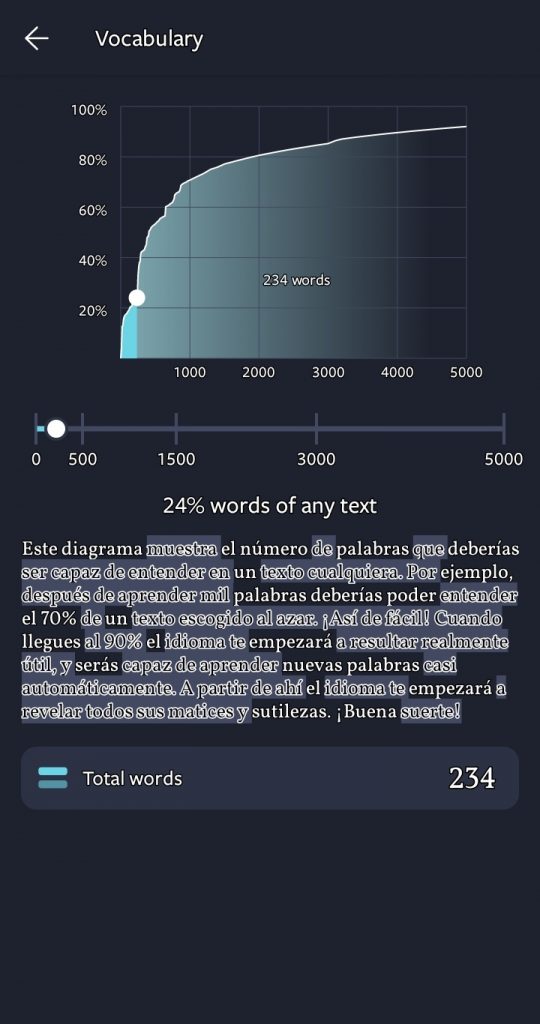
I find that chart motivating and daunting. I have a long way to go, but based on 2 weeks of use I can read 24% of any text I come upon. Anecdotally, I find that to be almost true – my reading comprehension is slightly higher than 24% due to the similarities between English and Spanish. I can understand the ads in my local tienda’s paper and read a fair amount of the articles. (The comic strips are the ones I sometimes don’t understand…)
They also have the option to complete the questions with audio. It will listen to you speak, detect if you are correct, and advance accordingly. I wish that it had more, complex audio prompts (this is where duolingo wins) but I find it is well integrated into the app and useful to the user. This app is also not free, but once you learn your words, you won’t need it anymore.
I have only used Lingvist’s Spanish (Latin American) course. It gets harder quickly, advancing from rote memorization of common words to requiring conjugation in multiple tenses. I recommend this app because it does not baby you. While duolingo’s lessons are fun, I find they’re not always the most relevant and are extremely repetitive. Lingvist’s approach to mastering the most common words appeals to my common sense and my desire to advance.
With this app, you will want to create your own conjugation charts at some point to solidify the concept. The app jumps right into conjugations of “to be” and in Spanish there are 2 verbs instead of just the 1 in English. Learning the differences between “estar” and “ser” were efforts independent of the app. The app does support grammar information, but I found I could find a short grammar video or extensive explanations with a quick internet search.
While that can sound a little extra, the tool is designed to help you learn new words, not teach you the language like a teacher would. It is a tool for people who WANT to learn the language. If you are not willing to put in some effort… well, you get in what you put out. And you probably won’t get a lot out of this app if you don’t try.